AN INTERACTIVE FIELD GUIDE TO EMBODIED NEUROSCIENCE
What if a brain’s wiring could help explain behavior?
This is bigger than a fly. Scientists are moving from mapping a brain to testing how its connections could drive a body in a world.
Explore the idea below, then follow the decades of research that made it possible. Now using actual NeuroMechFly anatomy. The browser controller is still a simplified exhibit—not the research brain itself.
Actual NeuroMechFly mesh shapes. Click a body part to explore it.
Preparing the specimen…
Drag to orbit · Scroll / pinch to zoom
SENSORIMOTOR ARENA 01
GO DEEPER / THE SCIENCE OF A RESPONSE
A drop of sugar. A cascade of questions.
How does chemistry become electrical activity, and electrical activity become movement? Try the feeding experiment above, then explore the mechanisms—and the gaps between this exhibit and the research.
01 / SENSATION
Flies can taste with their feet.
Gustatory sensory neurons occur on the legs and mouthparts. Appetitive stimulation can contribute to a proboscis extension response. Taste is not the same as smell: antennal olfactory pathways sense volatile chemicals, whereas taste generally depends on contact.
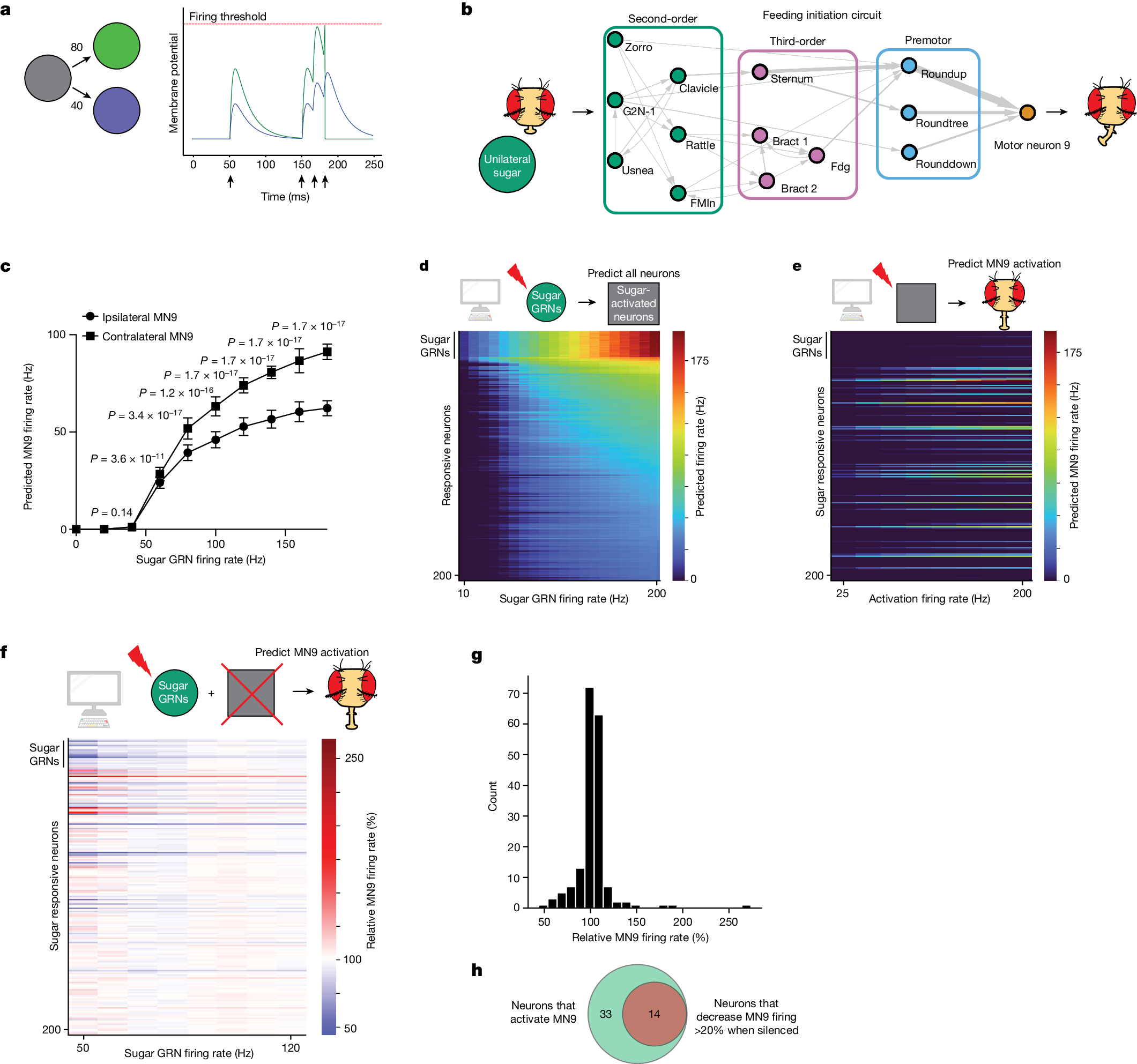
Shiu and colleagues used connectivity and predicted neurotransmitters to build a simplified spiking model. Activating sugar-sensing neurons generated predictions about downstream activity and neurons involved in feeding initiation, including MN9-related output.
The mouthparts unfold to bring the feeding surface toward a source. Real responses depend on context and internal state. Here, two added MuJoCo hinges animate the original mouth meshes; appetite and concentration are transparent toy rules, not fitted biological parameters.
INTERACTIVE / ONE NEURON, NOT A FLY BRAIN
Build up a signal. Cross a threshold.
A leaky integrate-and-fire neuron is a simplified model: input raises a membrane-potential variable, leak pulls it back down, and crossing a threshold generates a spike followed by a reset.
Increase the input, add inhibition or change the time constant. Then send a pulse. This explains one modeling idea used by Shiu et al.; it does not reproduce their parameters, network or measurements.
NORMALIZED POTENTIAL0.00
TOY-MODEL SPIKES0
Normalized, slowed-down educational units. No measured neural activity.
What is a connectome—and what does it leave out?
A connectome records structural connections. It does not, on its own, specify every channel, synapse dynamic, neuromodulator, hormonal state, memory or learning rule. Connectivity constrains what a model can do, but additional assumptions are needed to make it run. That is why behavioral and physiological validation matter.
How does a microscope image become a brain map?
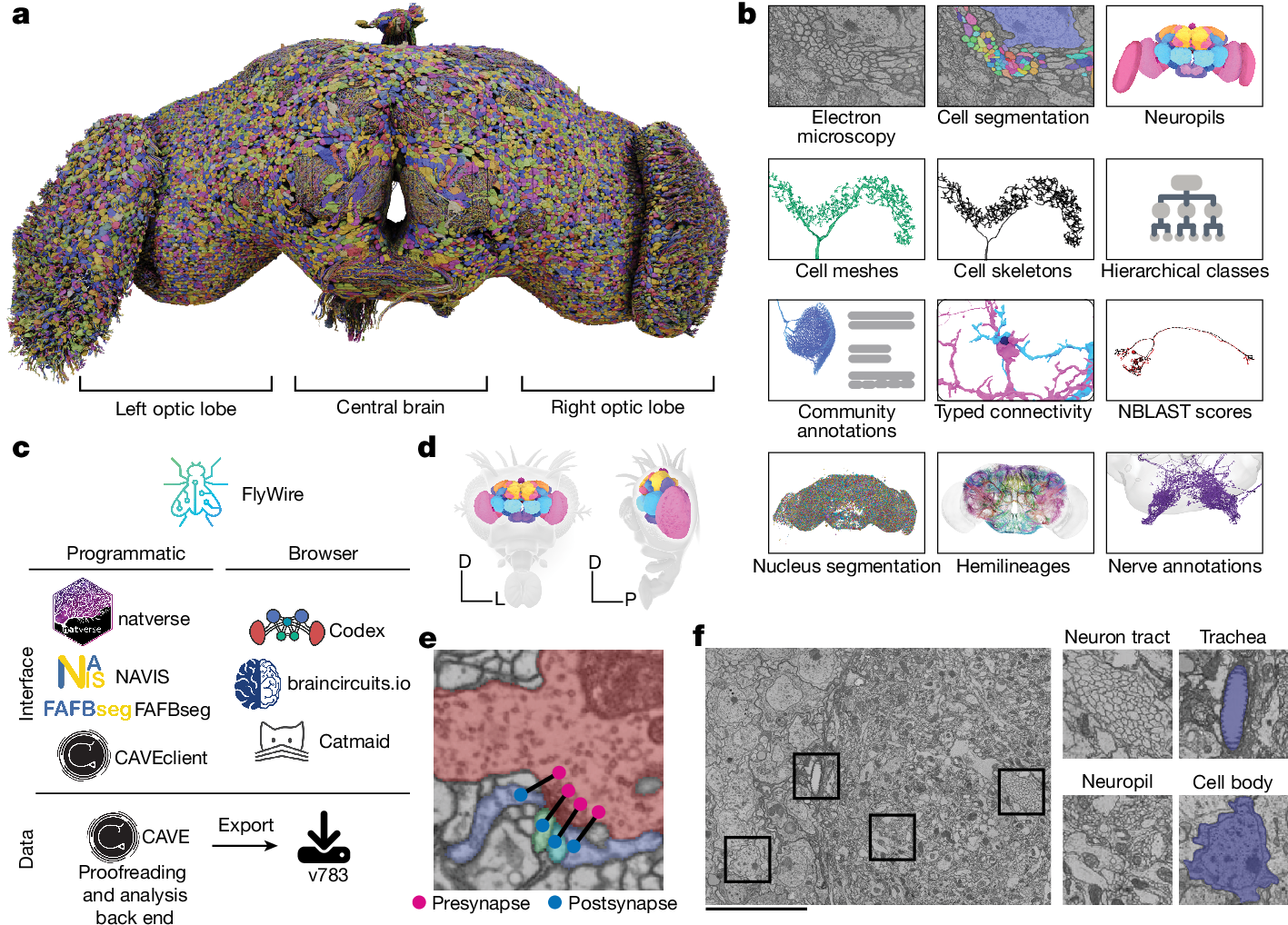
Electron microscopy reveals structures at fine spatial resolution. Reconstruction requires tracing cells across images, identifying synapses, proofreading segmentation and annotating cells. FlyWire combines machine assistance with extensive human and community work. The 2018 image volume, 2020 hemibrain and 2024 FlyWire reconstruction are distinct milestones, not interchangeable datasets.
What connects a brain model to a body?
Descending neurons carry signals toward downstream motor systems. A simulator still needs a mapping from neural output to controllers or forces. Eon reports hand-selected brain–body mappings and substantial reliance on existing NeuroMechFly controllers. Their technical account also says visual model activity did not yet substantially influence behavioral output in that version.
Drosophila combines a comparatively small nervous system with rich behavior and a long history of genetic, physiological and behavioral tools. This makes it possible to compare computational predictions with targeted experiments. It is not a claim that a small brain is simple or that success transfers directly to a human brain.
What would make an emulation convincing?
Matching a video is not enough. Stronger evidence would compare neural dynamics, responses to perturbations, sensory processing, behavior across environments and internal states, and predictions on tests not used to construct the model. Accuracy is a spectrum, not a badge conferred by the word “upload.”
WATCH / FOLLOW THE SOURCES
See the story. Then inspect the evidence.
Direct links to the actual video and its published chapter timestamps. These open on YouTube—nothing autoplays here. The video is commentary; the papers and Eon’s methods are the sources for technical claims.
A wiring diagram tells us which neurons connect. A simulation asks what those connections might do. Put that model in a body, and its outputs must deal with the consequences of action.
139,255neurons in the 2024 adult female FlyWire whole-brain reconstruction
~50 millionchemical synapses mapped in that same research dataset
One closed loopsensation → neural activity → movement → a new sensory experience
Not generated illustrations. These figures show the distinction between reconstructing anatomy and testing a computational model.
THE MAP / 2024
From electron microscopy to a whole-brain network.
The FlyWire reconstruction combines images, segmentation, proofreading and annotation. The colored structures are reconstructed neurons—not a live activity display.
Shiu and colleagues modeled how signals propagate and tested predictions about neurons involved in feeding initiation. A useful model must explain more than the appearance of movement.
Select a chapter. Each breakthrough solved a different part of the problem.
CONCEPTUAL ILLUSTRATION / NOT CONNECTOME DATA
1986 / A FOUNDATIONAL MAP
Before a fly, there was a worm.
White, Southgate, Thomson and Brenner published their landmark reconstruction of the nervous system of C. elegans. It helped establish the ambition of connectomics: understand a nervous system by tracing its connections.
WHAT CHANGED
A nervous system could be treated as a concrete network to reconstruct—not only as a collection of isolated cells.
According to Eon’s own methods, the brain–body interface uses hand-selected signals and mappings. A moving fly is not, by itself, evidence that every internal neural dynamic is biologically correct.
THE KEY IDEA / EMBODIMENT
A map is not yet a behaving animal.
The important step is feedback. A brain model sends a motor command. The body moves. That movement changes what the model senses. Now the model must respond to a world it helped change.
01SenseA cue enters the system
02ComputeA model transforms the input
03ActA body changes its world
↺Sense againThe consequences return as input
01 / NEUROSCIENCE
Make explanations testable.
Change a connection or activate a circuit in a model, predict a behavior, then compare it with a real animal. The value is a hypothesis you can test—not an animation that merely looks alive.
02 / EMBODIED AI
Study intelligence in context.
Biological control depends on a body and its environment. These models give researchers a way to investigate how sensing and movement cooperate, and may inform new approaches to robotics.
03 / OPEN SCIENCE
Let others build on it.
Published connectomes, open body simulators and open physics tools let different teams inspect, challenge and extend the work. The progress comes from many contributors, not a single “upload” moment.
THE DISTINCTION THAT MATTERS
Extraordinary progress. Not proof of a copied mind.
A connectome is not a complete account of a living brain. Cell dynamics, learning, internal state and the brain–body interface still matter. Eon’s own account describes hand-selected mappings, existing body controllers and significant unvalidated dynamics.
Here on this page: real MuJoCo physics, original NeuroMechFly anatomical mesh assets with modified browser dynamics, scripted behaviors and an illustrative signal network. Not running here: the FlyWire connectome, Eon’s brain model, a memory upload or a consciousness simulation.